WRONGROOM

My adventurous projects in the world of audio-electronics.

warning : I'm a musician, NOT an electrician. What I do to my own equipment, is not necessary correct! I enjoy doing DIY stuff, and thought it was cool to put up a kind of studio tech-diary, a modding-log

Thank you for looking, and I hope you enjoy what you find here!

best, Kaada

Dec 10, 2009

transformer based guitar bass recording channel


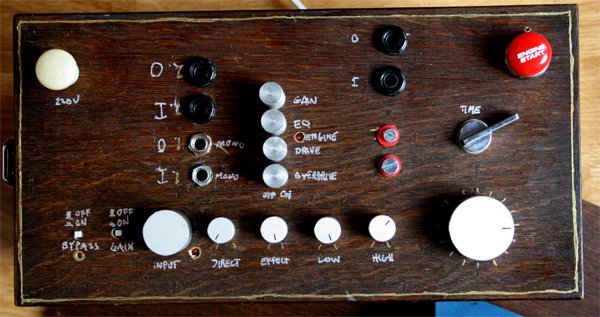
Here's the recording channel that is being built these days. I wanted to learn some more about impedance issues concerning guitars, bass and amps, and there's no better way to learn than to build something. So off we went.zoom in on picture for details.active DIs on each input, with different transformer options. class A circuitry, balanced, two filters and two send/return with blend option. This unit will consist of independent buildingblocks, so that it is easy to modify and swap certain parts later.

Labels: , ,

Jun 18, 2009

neumann EQ


A w492 equalizer built in a 3U box. Jørgen Schou transformer on input, Sowter on output.

Labels:

May 20, 2009

DIY The Analag Poorman Fairchild 670


Labels: ,

Apr 16, 2009

6As6 tube injector

These electronic projects are just getting more and more fun for each build! I´m hooked and actually addicted to this stuff now. No way out. must.... build ...more...agh...bzzzss-.....zap!

A tool for getting some life and soul into samples or a bit of tub'ish harmonics into tha tracks. This is a clone of a more famous tube distortion, but the schematics can and will not be shared. sorry. have to keep these papers for my-selves. anyways, it functions as a tape-emulation, but with two 6AS6 tubes for stereo. 10K:10K transformers on both in and output. stepped attenuators and a Voltage Regulator Stabilizer Tube in the PSU. Mostly wima caps in the audio chain. They gave a more "crispy" sound than the other caps I tried. By the way, you just can't go wrong with Wimas. E88cc tube on the output

Labels:

Feb 22, 2009

dual LA-2a with switchable input iron - 1:1 and 1:9


Labels: ,

Jul 26, 2008

DIY 33609

A Neve 33609 is born. 10000 thanks to Igor (tech-genius) for the pcbs and for all the group-diy guys! Got me some old Belclere trannys on the inputT1 & int.T2 and Carnhills on the output. Aiai, I still cannon believe how unbelievable cool it sounds, and how veritable it is.

Labels: , ,

Jun 6, 2008

homebuilt vacuum tube compressor

Fuck I'm starting to get fat from sitting here doing electronics all day. So I decided that I'd rather spend some time on an update than soldering and crying, picking at the scabs around my genitals. Here is my new home assembled compressor. Sidechain for lowend and saturation control build in. Thanks to everyone at the prodigy-pro forum for valuable info and inspiration

Labels: , ,

Mar 12, 2008

yeah recapping man

damn, how important it is for musicians and studio owners to know how to recap. I honestly didn't know how much diffenence it could do. If you wanna take it further than just recapping, and are looking for a well written electicity-book, I would recommend a book called “Tab elecronics : GUIDE TO UNDERSTANDING ELECTRICITY AND ELECTRONICS”. This is the first book that I really enjoyed reading, and that finally made me understand the concept of good biasing among other things.

today, I worked on my Fender Twin. After recapping, it felt like the cleanest Fender, most beautiful amp, ever. If you're into vintage instruments and stuff, then you have to get comfortable heating that soldering iron.


and here's a pic of my recapped ol' Peavey Classic. Didn't have 200uF caps for the PSU, so I put two 100uF in parallel. The springs and the depth-tremollo in the old peaveys are extremely cool.
oh, When I record 4x10 or 4x12 cabinets, I often disconnect all but one speaker. Depends on the song off course, but generally the sound gets cleaner and easier to work on when it only comes from one speaker instead of four.

Labels: , ,

Feb 9, 2008

homemade summing unit

DIY summing...Using it for summing my external FX's, together with a neve 8816 - Based on a Neumann 475-2a and a bunch of 5.11K resistors.


Labels:

Feb 1, 2008

DuKane Limiter (model 2A80B )

It was time to try to make an old stocked DuKane limiter work again.  It was unfortunately impossible to find schematics it, so by trial and error I did some mods, and swapped out most of the old components. Here's what I did : 1) All caps swapped, and the big 0.47 filmcaps was changed to smaller types, to adjust attack and release to normal lengths. 2) Installed new transistors on input and output 3) new grounding 4) new PSU parts 5) The 5K trimpot in the compressor psb was moved to a new pot on the tront where the channel2 was before. 6) The socalled noise-gate was dropped (the psb to the left) 7) The limiter on/off button and the ratio button on the back was dropped cause they did nothing good. 8) shelded cables on the audio-cables 9)installed stereo-jack in and outputs

after "fixing"  (click to enlarge):
AND THE RESULT OF MY STRUGGLING AND AMATEURISH FIXING : Well,.... though the sound got cleaner, I dissembled the DuKane again after one week of testing. There was an snap-sound in the compressor-attack that made it too uninspiring to work with. Hopefully, I learned something. This one goes in the trash. What a shitty compressor, what a waste! 

Labels: ,

Jan 27, 2008

CUBE60-BASS


Colleagues and other musicians are asking me why the f*** I spend so much time studying electronics and modding my gear, instead of doing what I should be doing, namely to make music! But to me there's just no difference. The process of making a unit sound better, or whatever effect, is just another side of making music. Beside I'm more conformable on stage when I know how my instruments work, and how they are built.

Todays DIY project was to fix an old bass-amp that I haven't used for ages. It's a Roland cube60-bass. It's a soft sounding amp, but for bass - especially in studio-use, is an advantage. The pink textile on the front is my fault...gulp. what can I say.


Here's what I did to the pcb : As a mod, I changed the uF values on the mid-tone EQ, and went for a bigger pot (250K). Then I swapped out the old caps, and found a stupid D22A diode, which I changed for a more normal type. don't remember exactly, think it was a 4148 diode. The grounding was tied up, new jackinputs and new caps.

Labels:

Apr 23, 2006

DIY BOLT -

If you have any electronics ability, modifying your own gear can be a very satisfying experience.

You don't need to be an expert to crack open your equipment and start making changes. You basically need the ability to solder and desolder neatly, and you should be comfortable reading schematics. With very little electronics experience, I've been able to modify several pieces of equipment.

Labels: ,

Apr 22, 2006

gear manipulations

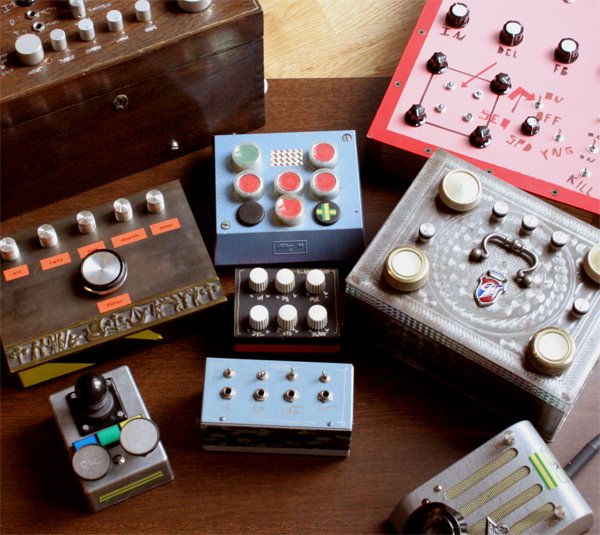
G-SPOT SPRING FLANGER- cheap - flangers have a tendency to lay itself on top of the sounds, instead of blending in they often sound superficial. I have installed a small spring-reverb into my Flanger. I grabbed the springs form two mini guitaramps and stringed them inside. It makes my job more exiting to create alterations of everyday instruments. Is there anything more joyful than a huge, massively over-engineered effects pedal covered in LEDs, tiny switches and retro synth knobs? There are many reasons people choose to modify commercial musical gear. Upgrading internal components like capacitors and op-amps can clean up the overall sound. Likewise, providing a cleaner power supply can reduce hum and increase headroom, and help add fullness to the low end. Adding extra controls and patch points to an analog synthesizer can yield a much more expressive instrument, and allow you to interconnect it with your other gear.


SUGARDADDY 3000

Is a combination of a wahwah, a delay and an boss overdrive
pedal. Circuit bending is the art of ripping apart electronic toys and turning them into sound/music-making devices. The process of circuit-bending involves taking cheaply available electronic soundmaking toys and adding extra wires, knobs and switches to make new connections between parts of the internal circuitry and chips.

Labels: ,

DIY - NOBODY'S PERFECT

Here's my hometweaked amps. They are not exactly "glassy clean" but has nice harmonics and a blues type distortion when cranked. The high gain channel picks up from there, going into heavy overdrive. So far I like em best with 12AX7-12AT7-KT66 tubes. Sometimes they serve a surprisingly pleasing and unmistakable sound quality, and other times they sound like dust. The one on your right has 4 jack inputs. I like to use it live as a selector between fuzzy&feedy vocalmics.

Labels: ,